Friday, June 05, 2015

More theft and dishonesty from the Al-Qaeda separatists...

ISIS is about to make A LOT of money off 'the archaeological equivalent of a beheading'


Palmyra(SANA via AP) A view of the ancient Roman city of Palmyra, located northeast of the Syrian capital of Damascus.
The Islamic State terror group continued its rampage across areas of the Middle East this week,seizing the ancient town of Palmyra in Syria.
Palmyra is strategically located — as The Wall Street Journal notes, it's at a crossroads between Damascus, the capital of Syria, Homs, a supply center for the Syrian army, and Deir al-Zor, a government stronghold.
Another big motivating factor for the terror group (also known as ISIS, ISIL, and Daesh) is money.
Palmyra is an ancient city that has been occupied for thousands of years and has seen many civilizations pass through it. It's home to a UNESCO World Heritage Site and many valuable artifacts.
Jonathan Schanzer, vice president for research at the Foundation for Defense of Democracies, told Business Insider that ISIS makes most of its money from racketeering, which includes collecting "taxes" from the residents who live within the borders of the territory it has taken over, plundering people's homes, and looting historical sites and selling antiquities on the black market.
"It’s a racket. And that’s how ISIS continues to survive and thrive," Schanzer said. "They need to jump from community to community in order to sustain themselves financially."
ISIS Islamic State Iraq Syria map(Reuters) 
Smugglers who talked to BuzzFeed News described Palmyra as a potential windfall to their business. One Syrian smuggler said he was sure ISIS would sell the artifacts they could get their hands on in Palmyra.
Museum workers reportedly removed as many artifacts as they could before Palmyra fell earlier this week, but there are likely many antiquities left behind that ISIS could still plunder.
"[The regime of Syrian dictator Bashar Assad] is trying to mitigate the damage and perhaps prevent ISIS from being able to cash in" on the antiquities in Palmyra, Schanzer said. He added that there is major profit to be gained from treasures that can be taken to market. Analysts are unsure of specifics, but ISIS could make tens of millions of dollars from one archaeological area, Schanzer noted. 
There's also evidence of ISIS digging up archaeological sites in other areas and taking whatever they can, according to The New Yorker. One archaeologist said some sites looked like "Swiss cheese" because of all the holes.
Palmyra(SANA via AP) This photo released on May 17, 2015, by the Syrian official news agency SANA, shows the ancient Roman city of Palmyra, northeast of Damascus.
ISIS likely works with smugglers who have networks in the Middle East and can transport looted goods into Turkey and other countries where there is a black-market demand for them.
"There are almost certainly going to be antiquities dealers waiting in the wings waiting to spirit this stuff out of [Palmyra]," Schanzer said. "In Turkey in particular … you’ve got these fairly lawless borders, borders that have been exploited repeatedly … so the assumption is that we’ve got established smuggling routes and people bringing illicit goods over the border."
The looting also serves another purpose: ISIS releases propaganda videos of militants destroying ancient sites in a bid to attract recruits and get media attention from the shock value of the destruction. Much of the media coverage surrounding the seizure of Palmyra focused on the fact that a UNESCO World Heritage Site was now in danger.
"The horror and shock, this is the archaeological equivalent of a beheading," Schanzer said. "Certainly there will be the shock value of this and that will jolt people."


https://uk.finance.yahoo.com/news/isis-lot-money-off-archaeological-145600262.html

Wednesday, March 11, 2015

'Heart, what happened?!'

http://theawkwardyeti.com/comic/news/


Why is this happening?

From here on in, I will only refer to ISIS as Al-Qaeda separatists. They are not 'Islamic', and they are not a 'State', and they certainly do not belong to Iraq or the Levant. I will not collude with their delusions of grandeur. They are a bunch of criminals so depraved, that even Al-Qaeda has distanced themselves from them.
They are an international hodge podge of power hungry, arrogant, criminals, united in the search for money, power and degradation and mass murder of civilians. They use religion as a smoke screen, a red herring to pull ordinary folk off the scent of their real intent. They have nothing to do with faith. The longer the general public is fooled by this, the longer it will take to deal with the real problem.

Their 'fighters' get paid at least double the monthly wage of an Iraqi soldier. Where is this money coming from?

They have weapons, that some states can not buy. Where did they get the money? Why is the arms industry selling to them?

They have actively sought to attack, take over, then somehow continue to run gas and oil fields. They have taken over most of the gas and oil plants in Syria, and at least 5 in northern Iraq. How are these plants still running (random untrained crazies are not going to be capable of this)? Who is buying the oil?
Interestingly, the price of oil internationally has gone down corresponding with the above take overs of natural resources. There are suggestions that this oil is being sold cut price, going over the border to Turkey, and being sold on to progressively bigger corporations.
Buying this oil is effectively fuelling the conflict. Why is there not an international response to ban the buying of illegally sourced oil by the corporations? Why is there not an international boycott to these murky practices that fund this international criminal activity?

This is about money, power and degradation. This has never been about religion. There is an element of cult like practices in some segments, and atrocious lack of rational thought, but this isn't the bigger picture, they are not the big fish. The longer we are fooled by their rhetoric, and believe their narrative, the longer this will go on, and the worse this will get.

They are an international mafia like corporation.
A lesson from history - Al Capone wasn't put away for murder. He was put away for tax evasion.
At this stage, we don't really know who the real 'Al Capones' are, but the income streams are increasingly clear.

https://uk.news.yahoo.com/video/release-video-bodies-captured-soldiers-083038368.html

Saturday, February 14, 2015

3 Muslim students murdered in the states

https://uk.news.yahoo.com/obama-condemns-murders-muslim-students-193919944.html#rhuZcO1


Obama Condemns Murders Of Muslim Students

US President Barack Obama has condemned the "brutal and outrageous" murders of three Muslim students in North Carolina.
"No one in the United States of America should ever be targeted because of who they are, what they look like, or how they worship," he said in a statement, offering his condolences.
He added: "As we saw with the overwhelming presence at the funeral of these young Americans, we are all one American family." 
Shaddy Barakat, 23, his wife, Yusor Mohammad Abu-Salha, 21, and her sister Razan Mohammad Abu-Salha, 19, were killed on Tuesday in the couple's Chapel Hill apartment.
Police have said they suspect the catalyst for the alleged murders by neighbour Craig Stephen Hicks, 46, was a parking dispute, but family members claim it was a hate crime.
The FBI has opened an investigation into the killings to run parallel to that by the local police force.
North Carolina investigators said on Friday that Hicks had at least 12 guns and a large cache of ammunition.
Muslim groups planned to hold Friday prayers in front of the White House as part of their call for a federal hate-crime inquiry.
Mr Obama's remarks on Friday follow criticism from Turkey's President Recep Tayyip Erdogan, a devout Muslim, of his US counterpart's "telling" failure to speak out about the killings.
On Thursday, more than 5,000 people attended the funerals of the students in a ceremony that spilled over from a mosque to an athletic field at North Carolina State University in Raleigh.
The fathers of the three young Muslims, standing before their coffins, said the killings were motivated by religious hatred.
"This has hate crime written all over it," said Dr Mohammad Yousif Abu-Salha, who lost his daughters.
"If they don't listen carefully, I will yell."
The murders saw the hashtag #MuslimLivesMatter trending on social media.
But US Attorney Ripley Rand, the district's top federal prosecutor, has said there was no immediate evidence Muslims were being targeted.
Hicks, 46, is a gun rights advocate with a concealed weapons permit who often complained about organised religion on Facebook.
He turned himself in and is in custody on first-degree murder charges.
The accused, a paralegal student at a local community college, had confronted other residents about parking and noise.
Neighbour Samantha Maness, 25, said Hicks was known in the apartment complex as someone with a short temper.
She described him as displaying "equal opportunity anger towards the residents here".
Hicks' ex-wife told the Associated Press he was obsessed with Falling Down, the 1993 movie about a jobless divorcee who goes berserk.
She said he showed "no compassion at all". 

Sunday, January 11, 2015

'Muslim Shop Worker Saved Jewish Customers'

http://www.msn.com/en-gb/news/uknews/muslim-shop-worker-saved-jewish-customers/ar-AA81jDT?ocid=LENDHP

'Muslim Shop Worker Saved Jewish Customers

A Muslim shop worker has told how he saved "15 to 20" customers at a Jewish supermarket attacked by terrorist Amedy Coulibaly.

Lassana Bathily was out of the gunman's view when he stormed the Hypercacher store in eastern Paris with guns blazing.

A number of shoppers fled down stairs at the back of the shop, where they ran into the 24-year-old assistant, who thought the group could hide in a cold storage room in the basement.
He has been credited with helping the hostages - including a father and his young son - to survive the siege, in which four were killed by Coulibaly.

He told France's BFMTV: "I went to the freezer, I opened the door and a number of people came in with me.

"I turned off the light and the freezer. I told them to keep calm, to not make any noise."
After managing to escape through a goods lift and an emergency exit, Mr Bathily was initially suspected of being a terrorist accomplice.

He said: "I ran out, I saw police officers who told me 'Lie down! Hands on your head!'"

After explaining who he was, Mr Bathily was able to provide officers with useful information about the layout of the store and where customers had been hiding.

After police stormed the building and killed Coulibaly, some of the freed hostages thanked him and shook his hand, he said.

Explaining why he acted as he did, Mr Bathily said: "We are all brothers. It's not a question of Jews, Christians or Muslims.

"We were all in the same boat, we had to help each other to get out of the crisis."
Mr Bathily's photo has been circulating on social media since his story emerged, with many users labelling him a "hero" or "the coolest man on the planet". '

Sunday, November 09, 2014

'Reality has no manual'

http://www.timeshighereducation.co.uk/comment/columnists/reality-has-no-manual/2012215.article


'Reality has no manual
27 MARCH 2014

How do you prepare students for the impossible? asks Kevin Fong

Every now and again, you wonder what you know for sure about your job. Right now, all I know for sure is that this evening, I must mark the coursework and write this column.
I know that part of my day job is to teach undergraduates, some of whom are going to be tomorrow’s junior doctors. It is a strange thing, teaching medical students and trying to work out what they might one day need to know. At the best of times, it feels as though we are not fully up to the task. At the worst of times, it feels less like a professional traineeship and more like Timothy Q. Mouse giving Dumbo the elephant a feather, shortly before he shoves him off a cliff.
Unlike those teaching the “proper” science students, you know something of what lies in store for them. You are getting them ready for something real. You are preparing them for the reality of the job, for the days when it is something other than swanning around wards sporting white coats and wearing stethoscopes like feather boas.
We do the naming of parts thing. Foist upon them a Haynes manual for the human body. And we are getting better, I guess. These days, we go beyond rote, beyond the simple remembering and regurgitation of facts. We prepare them in our classrooms to snipe confidently at someone else’s study, to query the quality of the case mix or the randomisation of the trial. We prepare them to see the wood from the trees in the evidence, to be cynical about the hard sell from some corners of the pharmaceutical industry. We help them to understand the difference between what they know and what they think they know.
Of all the things you should prepare your students for, it is days like this. The stuff that isn’t art or science. Only you know there are no courses for this
This we can do. We even teach them something of the softer skills that doctors need: the breaking of bad news and the ethical dilemmas; the questions for which there are no right answers. These days, it seems that there are courses for everything.
They are better students than we ever were. They should be. They have a thousand different teachers available, literally at the push of a button, waiting patiently 24/7 on the end of a URL. They are awash with knowledge, given in good faith, sloshing down digital pipes, spilling off the pages of e-journals. Everything the independent-minded, gifted autodidact needs to be a doctor.
Except that there are other days. Days when the job is not about paperwork or the evidence or the grade you got in your final exam. When there is no intellectualising the challenge, when having a telephone book’s worth of facts in your head makes no difference.
When things start badly and get worse. When you face stuff that isn’t in the books, when you have to run, when you leave a mess of bloody footprints trailing along the corridor, when you finish the case with your gloves wet and dripping crimson. When, in a state of something near panic, you deliver into the hands of a more capable and better equipped team, your sickest patient, and you stumble over the words as you urgently spit out a stream of what you consider essential information, but which, to the people who have just gathered around, is little more than a set of slick phrases and impenetrable jargon that together simply mean “help me”.
On those days, your colleagues later stand beside you, asking if you are OK over and over again, without your understanding precisely why. Until you look at your feet and your hands and then the patient and yourself. And later, when it is over and you are filling in the paperwork, they tell you that everything that could have been done was done. That nothing would have made any difference.
Of all the things that you should prepare your students for, it is days like this. The stuff that isn’t art or science. Only you know for sure that you can’t. There are no courses for this.
And on days like this you ask yourself again if everything that could have been done was done. You rake over it with colleagues, combing over the detail, the timings, the decisions, the interventions. You do the “whys” and the “whens” and the “what ifs”. You ask yourself if you could perhaps have done something that would have made a difference, if there was a chance to escape to a better outcome. Finally, you realise that you don’t know and never will. And you ask yourself again what you know for sure about the day. And all I know for sure is this: that tonight, I have to mark the coursework and write this column.'

AUTHOR:

Kevin Fong is a consultant in anaesthesia, honorary senior lecturer in physiology at University College London, and a Wellcome Trust Engagement Fellow.

Wednesday, October 29, 2014

Switzerland's forgotton children and past

http://www.bbc.co.uk/news/magazine-29765623


Switzerland's shame: The children used as cheap farm labour

Boy

Thousands of people in Switzerland who were forced into child labour are demanding compensation for their stolen childhoods. Since the 1850s hundreds of thousands of Swiss children were taken from their parents and sent to farms to work - a practice that continued well into the 20th Century.
David Gogniat heard a loud knock on the door. There were two policemen.
"I heard them shouting and realised something was wrong. I looked out and saw that my mother had pushed the policemen down the stairs," he says.
"She then came back in and slammed the door. The next day three policemen came. One held my mother and the other took me with them."
At the age of eight, he was in effect kidnapped and taken away to a farm. To this day he has no idea why.
For the first years of his life, he and his older brother and sisters lived alone with their mother. They were poor, but his childhood was happy until one day in 1946, when he came home from school to find his siblings had disappeared.
A year later it was his turn.

He was taken to an old farmhouse and became the farmhand. He would wake before 06:00 and worked before and after school. His day finished after 22:00. This physically imposing man in his 70s looks vulnerable as he remembers the frequent violence from the foster father. "I would almost describe him as a tyrant... I was afraid of him. He had quite a temper and would hit me for the smallest thing," Gogniat says.


Two boys
Watch Kavita Puri's report Switzerland: Stolen Childhoods on Our World at 11:30 GMT on Saturday 1 November and at 2230 GMT on Sunday 2 November on BBC World News. Assignment is on BBC World Service radio from Thursday.

On one occasion, when he was older, he remembers he snapped, grabbed his foster father, pushed him against the wall and was about to hit him. The man threatened him: "If you hit me, I'll have you sent to an institution." David backed off.
His siblings were living with families in the nearby village, though he rarely saw them. He missed his mother desperately. They wrote and there were occasional visits. One day his mother made an audacious attempt to get her children back. She came up with an Italian couple in a Fiat Topolino and said she was taking his siblings for a walk. David wasn't there but it was the talk of the village when he came back that night. The police brought the children back three days later.
"The fact that my mother arranged to kidnap her own children and take them back home to Bern with her just goes to show how much she was struggling against the authorities," Gogniat says. On his mother's death he made a shocking discovery. He found papers which showed she had been paying money to the foster families for the upkeep of her four children, who had been forcibly taken away from her and were working as indentured labourers.
Gogniat, his brother and two sisters were "contract children" or verdingkinder as they are known in Switzerland. The practice of using children as cheap labour on farms and in homes began in the 1850s and it continued into the second half of the 20th Century. Historian Loretta Seglias says children were taken away for "economic reasons most of the time… up until World War Two Switzerland was not a wealthy country, and a lot of the people were poor". Agriculture was not mechanised and so farms needed child labour.
David with his younger sister before they were sent away David Gogniat with his younger sister before they were taken away from their mother
If a child became orphaned, a parent was unmarried, there was fear of neglect, or you had the misfortune to be poor, the communities would intervene. Authorities tried to find the cheapest way to look after these children, so they took them out of their families and placed them in foster families.
"They wanted to take these children out of the poor family and put them somewhere else where they could learn how to work, as through work they could support themselves as adults," says Seglias.
Quote: "It was like a kind of punishment. Being poor was not recognised as a social problem it was individual failure."
Dealing with the poor in this way she says was social engineering. If a parent dared to object, they could face measures themselves. "They could be put in prison or an institution where you would be made to work, so you could always put pressure on the parents."
Mostly it was farms that children were sent to, but not always. Sarah (not her real name) had been in institutions from birth, but in 1972, at the age of nine, she was sent to a home in a village, where she was expected to clean the house. She did that before and after school, and at night cleaned offices in nearby villages for her foster mother. She was beaten regularly by the mother, she says, and at the age of 11 started being sexually abused by the sons at night.
This is the first time she has spoken about her story and her hands shake as she remembers. "The worst thing is that one sister, their daughter, once caught one of those boys... while I was asleep and she told the woman... [who said] that it didn't matter, I was just a slag anyway," Sarah says. A teacher and the school doctor wrote to the authorities, to express concern about her, but nothing was done.
There was no official decision to end the use of contract children. Seglias says it just naturally started to die out in the 1960s and 70s. As farming became mechanised, the need for child labour vanished. But Switzerland was changing too. Women got the vote in 1971 and attitudes towards poverty and single mothers moved on.
I found an exceptionally late case in a remote part of Switzerland. In 1979, Christian's mother was struggling. Recently divorced from a violent husband she needed support.
Christian with his mother Christian with his mother
Instead, the state took her seven and eight-year-old sons to a farm many hours away by car. Christian remembers getting out of the car and watching his mother and the woman from social services driving off.
"My brother and I stood in front of the house feeling very lost and didn't know what to do… it was a strange moment, a moment you never forget," he says.
On the first day they were given overalls and perfectly fitting rubber boots, "because before the placement the woman from social services had even asked what size shoes we wore… When I think back I do believe there was an awareness that my brother and I would be made to work there."
There was work before and after school, at weekends and all year round. He remembers one incident, at a silo where cut grass was kept to make into silage. "In winter it was pretty frozen and I had to hack quite hard with the pitchfork and I was put under pressure and then this accident happened and the fork went through my toe."
Christian says work accidents were never reported to his mother or social services. And if the boys didn't work hard enough there were repercussions. Food was withheld as a form of punishment.
You need to install Flash Player to play this content.
"My brother and I just went hungry at the time. When I think back there were five years during which we constantly went hungry. That's why my brother and I used to steal food," Christian says. He remembers they stole chocolate from the village shop - though he now thinks the owners knew the boys were hungry and let them take the goodies. A former teacher of Christian's at the local school says with hindsight he looked malnourished.
But there were also more serious consequences if Christian didn't work hard enough, including violence. "We were pretty much being driven to work," he says. "There were many beatings, slaps in the face, pulling of hair, tugging of ears - there was also one incident involving something like a mock castration."
Christian has no doubt why he and his brother were placed with the farmer. "I believe it was about cheap labour... we were profitable," he says. "They expanded the farm... it was five years of hard work."
When I visited Christian's mother, Svetlana, she took out a letter he had written to her during his time with the foster family. Christian himself hadn't seen it for nearly 30 years.
"It's a very strange letter. It's my handwriting but not my words," he says. It's a rhyming poem in German, sent to her on Mother's Day, and it accuses her of failing to look after her children. Svetlana cries as Christian translates it into English. "We are never washed and usually not combed, the socks had holes and the shirt was dirty," he says.
Poem written in Christian's hand to his mother
For Mother's Day: We would never be washed, and mostly not brushed, our socks would have holes, our shirts were dirty, we would eat fish with honey, and cauliflower with cinnamon if you didn't take care of us. We would have wet feet, and black teeth like soot, and would be covered up to our ears in prune mousse. We couldn't sleep if you didn't come and take us in your arms before we slipped into our dreams. And still we are sometimes a burden, but what would you be without children? Be glad you have us.
His mother has been unable to read this for decades. "I was being humiliated, portrayed as a bad uncaring mother without a heart or soul," she says.
"We were forced to write these letters," Christian remembers. "There was constant control… no boy could have written that." Around the borders of the letter are Christian's childlike drawings. And there is a sticker of a heart with the word "love" written across it.
Quote: They came as babies... and the bigger they grew the more work they would do
Archive photo of boys with a basket of vegetables
Historians estimate there were hundreds of thousands such children. For one year alone in the 1930s, records show 30,000 children were placed in foster families across Switzerland.

Start Quote

Loretta Seglias
They were being abused and no-one believed them”
Loretta Seglias Historian
"It's hard to know precisely how many contract children there were as records were kept locally, and sometimes not at all," says Loretta Seglias. "Some children were also placed by private organisations, or their own families."
The extent to which these children were treated as commodities is demonstrated by the fact that there are cases even in the early 20th Century where they were herded into a village square and sold at public auction.
Seglias shows me some photographs. One child looks barely two - surely she couldn't be a contract child? "She could, she would be brushing floors bringing in the milk. Sometimes they came as babies on to the farms, and the bigger they grew the more work they would do," Seglias says.
In her studies, and speaking to former contract children she finds recurring themes. The lack of information comes up again and again.
"Children didn't know what was happening to them, why they were taken away, why they couldn't go home, see their parents, why they were being abused and no-one believed them," she says.
"The other thing is the lack of love. Being in a family where you are not part of the family, you are just there for working." And it left a devastating mark for the rest of the children's lives. Some have huge psychological problems, difficulties with getting involved with others and their own families. For others it was too much to bear. Some committed suicide after such a childhood.
Social workers did make visits. David Gogniat says his family had no telephone, so when a social worker called a house in the village to announce that she was coming, a white sheet was hung out of a window as a warning to the foster family. On the day of this annual visit David didn't have to work, and was allowed to have lunch with the family at the table. "That was the only time I was treated as a member of the family… She sat at the table with us and when she asked a question I was too scared to say anything, because I knew if I did the foster family would beat me."
David with his foster family and another unidentified boy David with his foster family and another unidentified boy
Sarah too remembers that visits were announced and that social workers were always welcomed with cake, biscuits and coffee. "I used to sit at the table too. It was always lovely, ironically speaking, but at least I knew I was being left in peace, that nothing was going to happen." She never spoke alone to a social worker during her stay with the family.
Christian doesn't remember seeing a social worker alone either. In his documents, social workers wrote that he was "happy". In one of the letters, a visit is announced, saying it doesn't matter if the children are at school. Christian shows me letters written by his mother, detailing her concern that they were being beaten, were malnourished, and doing agricultural labour. His mother organised a medical assessment, on one of his rare visits home, and the doctor's conclusion was that he was psychologically and physically exhausted. This triggered his removal from the farm in 1985, when he was 14. His older brother, left at the same time. They were then sent to a state-run institution.
Boots and shoes at the exhibition
An exhibition which opened five years ago, and is still running today at the Ballenburg open-air museum, awoke modern Switzerland with a shock to its dark past of child exploitation. The man behind it, Basil Rogger, says that from the 1920s on there was a constant flow of pamphlets, autobiographies, and newspaper articles about the plight of the contract children. Their history was not a secret. If you wanted to know about it you could.
By the time of the exhibition, a generation had passed since the practice had died out, and there was enough distance to cope with it. Crucially, he says, the state was prepared to address the issue. Contract children who thought their experiences were isolated realised they were not alone, and began to share their stories.
Visitors also began to ask questions within their own family - Rogger says when he met people weeks after the exhibition they would tell him someone in their family was a contract child. "So people became aware of the omnipresence of this system, because almost any Swiss person knows someone placed in a foster family."
In recent years there has been a process of national soul-searching. Last year an official apology was made to contract children, and other victims of the state's compulsory measures - people who had been forcibly sterilised, or unlawfully detained.
Quote: "People who suffered for decades... were ashamed of their story"
Archive photo of boy in ill-fitting clothes
The Swiss Parliament, the Bundeshaus is buzzing. The campaigner Guido Fluri has just got the 100,000 signatures for a petition that could put the question of compensation to a national referendum. It's calling for a restitution package of about 500 million Swiss Francs (£327m) for the 10,000 contract children estimated to be alive today, as well as others wronged by the state's coercive measures. The petition was launched in April. Fluri says its success shows how strongly the Swiss people sympathise with the contract children.

Start Quote

Guido Fluri
Many who have experienced such severe suffering feel that wounds are being reopened”
Guido Fluri Campaigner
He is in parliament lobbying politicians to win their support for the petition. He explains to parliamentarians the plight of survivors - "people who suffered for decades, who fought, who were never able to leave their trenches, who hid away, who were ashamed of their story… some of whom are living in neglect". It's not just money, he says. "What's important is to point the way towards acknowledging that huge suffering."
The Farmers Union agrees with the principle of compensation, but is adamant that farmers should not have to contribute. You have to understand the times in which these children were placed into foster care, says union president Markus Ritter. Councils and churches had no money. Farming families were asked to take children who had fallen on difficult times or had one parent so the farmers were fulfilling a social function. Does he acknowledge abuse occurred? "We received a lot of feedback from children who were treated really well… But we are also aware that some children were not treated properly."
Guido Fluri says this social re-examination is liberating for some former contract children. Many elderly people come on crutches and in wheelchairs to his office to discuss their stories with him. The other day he found a poem left on his desk. For others, public discussion is too much to bear, and Fluri has received death threats. "Many who have experienced such severe suffering feel that wounds are being reopened," he says. "You can understand. They are completely overwhelmed by the situation."
It's taken a long time for the drive for compensation to reach this point, and there could still be many years of parliamentary discussion more before it becomes a reality. Loretta Seglias says the issue of restitution is a complicated one in Switzerland. "There is this fear of having to pay compensation... Some will say who else will come forward?" The experience of war reparations has left a scar.
Quote: "Who was responsible for the fact we were taken away?"
David Gogniat standing by a truck
David Gogniat, who left his foster family when he was 16, is now 75. He runs a successful trucking business. He arrives with his wife at the Bern archive. Since July, former contract children have had the right to access their childhood files.
David started the search into his past two months ago. He waits nervously outside in the autumn sunshine.

Start Quote

Many are probably afraid to read those files because they don't know what to expect”
Yvonne Pfaffli
"To me it feels as though there was some sort of an agreement between the farmers and child services to provide children as cheap labour," he says. But he only wants to know one thing: "Who was responsible for the fact we were taken away?"
He accepts that he may end up feeling disappointed, but he also thinks this could help him move on.
Once inside, he waits in a modern glass room. Yvonne Pfaffli, who has found his records, arrives with two files. I leave David in private to absorb it all. A while later, earlier than I expect, he emerges.
"Things came to light that I hadn't heard of or seen before, and I think I need to look at it again some other time," he says. Later, he tells me he learned something about his father, and some intriguing financial information - but he doesn't divulge details. He just seems relieved to have held the files of his childhood in his hands.
Over many more visits to the archive he will now try to piece together the mysteries of his past.
Many people have big gaps in their knowledge, says Pfaffli. They may remember being taken away in a black car, without ever having known why.
"They didn't know that it might be the result of something like their parents' divorce," she says. "These are very big questions, and many are nervous, and many are probably afraid to read those files because they don't know what to expect, but on the other hand they are hugely grateful that these files exist."
The documents have usually been written by social services staff and their perspective may be very different from the child's. There tends to be no mention of abuse.
Yvonne Pfaffli Yvonne Pfaffli with files from the archive
Sarah, now 51, left her foster family at 15 for an apprenticeship and never went back. She too has her file, though she was shocked at some significant omissions. Letters from her school doctor and teacher expressing concern about the way she was treated are not there, she says. Neither is a letter from the local authority apologising for placing her with an inappropriate family, which she says she was only ever allowed to read and not keep. With the help of the Verdingkinder network she is trying to trace them.
"What's also missing is the bit explaining why I was placed in that family in the first place, who made the decision, how it even came to that, so my files are anything but complete," she says. "And that's a shame. All we want is our story, and then we can draw a line under it… I am by no means certain whether the authorities aren't just putting up a front when they say they're helping us. For me there is a question mark."
Christian got his files back in July. "It's very very important. It's my life. It's also important for coming to terms with it in a historical and scientific way," he says. He has many questions: why they were taken away, and why so far away from their mother? Did the authorities know about the work they were doing. Did they know about the polio-arthritis he began to suffer from while living with the foster family? He says the report from a psychologist that triggered his removal from the farm is missing. He is still studying the 700 pages.
He shows me letters from his mother documenting her concern about her sons' health and the fact that they were not allowed to go to secondary school.
There is a contract with the farmer showing his parents' contribution to the foster family of 900 Swiss Francs a month, later increased.
But some former contract children find that no files remain. "Either they have been destroyed a long time ago, or more recently," says historian Loretta Seglias. "Some get answers… others don't."
Quote: "We congratulate him on these lies he cooked up!"
Two boys with no shoes carrying a crate Two unidentified contract children
Christian's foster parents agree to meet me - and are open to meeting him. One early morning we make the journey to the countryside.
Before we get in the car, Christian tells me he doesn't expect an apology, but by talking about what happened, he thinks, maybe they will reflect on how they behaved. As we drive into the countryside the views are breathtaking. Christian looks out of the window. "I am feeling very complex emotions. The landscape that used to give comfort to me as a child is giving me comfort now, but I'm also a bit speechless. It's difficult... I am feeling nervous as I have no idea what will happen there."
As we enter the village, Christian points out the village shop where he used to steal chocolate as a child. It's had a makeover three decades on. He becomes palpably anxious as we approach the farm. He wants to be left at a nearby river while we conduct the interview.
I approach the picture-postcard farmhouse. After some time, the farmer and his wife emerge. They agree to talk but on the condition of anonymity. They deny all of Christian's allegations - describing them as "lies". They say he never worked before or after school… maybe during the holidays he swept the stables. And they insist they were never violent towards Christian or his brother.
"No. You shouldn't hit children," says the farmer. "On the contrary" says his wife "with hugs, we tried with love." I mention the mock-castration, "Ha, castrate!" the farmer shouts. "What else? Those are some memories he has!"
Some of the farmhouses have been dismantled and erected as part of the exhibition Farmhouses have been erected at the museum to show traditional rural life in Switzerland
It infuriates him when I say Christian said he felt as if he were a contract child. "No, he wasn't a contract child, he was no contract child, we had them as if they were our own children," says the farmer.

Start Quote

I don't know where my journey will take me, I just know I want to fight for something”
Christian
I show them the Mother's Day letter. The farmer's wife denies asking Christian to write it. She attempts to tear it. "Don't roll it up," the farmer says under his breath. "Well, what should I do with this piece of paper? Burn it?" his wife asks him. They return it.
I ask how it feels three decades on to have these allegations made against them. "It's a saddening feeling, very sad," says the farmer. His wife adds: "I was so attached to those two."
But they refuse to see Christian. "We congratulate him on those lies he cooked up!" she says. The farmer adds: "I wouldn't even look at such a person with my backside."
Afterwards, I tell Christian there will be no meeting. "In some ways it makes me very, very sad because I was here, he had the opportunity to speak to me… I had prepared myself to talk to him and I would like to have confronted him with these questions in person and seen whether he would also have told me it was lies."
Christian walks back to the car, limping because of his arthritis. On the way back he is silent. Just before reaching home he tells me he has the same feeling of dread he used to have when going back to the farm. He seems fragile.
"I don't know where my journey will take me, I just know I want to fight for something that needs to be done," he says. "And I want to take responsibility not just for my brother and myself but for others in my generation as well."
Because it all happened so long ago, it is no longer possible for charges to be brought against the farmer, should the authorities have wanted to. Very few prosecutions have ever taken place against the foster parents of contract children, or the social workers who failed them.
Quote: "You'd somehow like to be normal, you'd like to pretend this had somehow never happened"
Girl who was a contract labourer
Sarah's home is covered with pictures of her children and grandchildren. She has a happy marriage. Her family know nothing of her childhood. She keeps the file containing her records away from the house so there is no risk of it being discovered. She attends contract children support meetings in a different city so she won't be recognised.
"I don't want to stand in my children's way - I don't want them to be snubbed because of me because of my past," she says. "Contract children still haven't found their place in society, we're still considered to be on a lower level, or even in the basement. That's why I'd rather the neighbours didn't know."
David Gogniat used to be Bern president of the Hauliers Association, and some members found out recently that he had been a contract child. "It then turned out some people I had done business with had grown up just like me," he says. "They later founded a club and a few weeks ago they invited me to visit, so I am now a member."
His goal is to get compensation for former contract children. "I was lucky to be healthy so I was able to work and managed to make a life for myself," he says. "But many were not that fortunate."
Christian, now 42, is an artist. His home is decorated with his sculptures and pictures. His career choice is no coincidence. "My brother and I were never encouraged to put our feelings into words, to describe them, and of course to express them without fear," he says. "Somehow I felt in art I learned to talk about my inner thoughts, the images inside me and also about the external impressions and images, so this path was very, very important for me."
Christian's mother, 2014 Christian's mother, 2014
His relationship with his mother has been damaged. "These events have completely torn my family apart," he says. His mother agrees. "I would say we have grown apart, we don't really have much in common," she says. "It's very difficult, even now."
Christian says the experiences of his childhood have left huge scars.
"You understand you are different, but you don't want to be different, you'd somehow like to be normal, you'd like to pretend this had somehow never happened."
Archive photos of verdingkinder courtesy of Paul Senn (1901-1953), Bern Switzerland; Bernese Foundation of Photography, Film and Video, Kunstmuseum Bern, deposit Gottfried Keller Foundation. © Gottfried Keller Foundation, Bern.
Watch Kavita Puri's report Switzerland: Stolen Childhoods on Our World at 11:30 GMT on Saturday 1 November and at 2230 GMT on Sunday 2 November on BBC World News. Assignment is on BBC World Service radio from Thursday.

Saturday, October 18, 2014

Starbucks coffee and ethics (or lack thereof)

http://www.ethicalconsumer.org/buyersguides/drink/coffeeshops.aspx

From the ethical consumer website

'Starbucks (Or ‘America’s Favourite Drug Dealer’ as the ‘Starbucks Gossip’ website calls it). Despite providing the Guantanamo Bay prison camp with Starbucks coffee kiosks(1)...Despite what the US National Lawyers Guild called its “relentless and illegal anti-union campaign” and “retaliatory firing” of union organisers(2)...Despite six settlements in three years for complaints to the US National Labor Relations Board of violating workers’ rights(3)...Despite providing its US staff with worse health care coverage than Wal-Mart and recently doubling health insurance costs(4)...Despite refusing for six years to give in to pressure from campaigners to ban the genetically engineered artificial ‘recombinant Bovine Growth Hormone’ from its dairy supply chain(5)...Despite criticism for what the World Cancer Research Fund called the “alarming” sale of iced coffee containing over a quarter of a woman’s daily calorie requirement(6)...Despite what Oxfam claimed was obstruction by lobbying against Ethiopia’s trademark applications for its traditional coffee varieties to boost income for some of the world’s poorest coffee growers(7)...Despite increasing CEO Howard Schultz’s income by 25% in 2009, a year in which the company slashed costs by $580 million, partly by reducing its work force by 19%(8)...Despite a US court ordering the company to pay more than $100 million into the accounts of its low wage staff in California after ruling that it had improperly required the workers to share tips with their bosses(9)...Despite petitioning a US Federal Judge to allow the past sexual history of a 16 year old former employee to be revealed in court after she went public over the company’s alleged “failure to act” in a case of aggravated sexual harassment, before settling out of court(10)... Starbucks somehow manages to maintain an image amongst a considerable number of consumers that it is simply a scaled up version of a bohemian Seattle coffee shop selling fairly-traded artisan coffees.
And despite all of the above it took allegations in the Sun in 2008 that the company was wasting 23.4m litres of water every day (enough to fill the ubiquitous Olympic pool “every 83 minutes”)(11) due to running a tap in-store non-stop, to dent the brand’s reputation in the UK.
Since then, with a multi-million pound advertising campaign stressing the company’s ethical credentials, you could easily be forgiven for thinking that the company had gone entirely Fairtrade. For the record, Starbucks is now the largest purchaser of Fairtrade certified coffee in the world and since the end of 2009 all of its espresso-based drinks (ie. the vast majority) in the UK and Ireland are 100% Fairtrade.
In the US, where consumers are far less attuned to the Fairtrade message, it’s another story. In the early 2000s the US Organic Consumers’ Association (OCA) was encouraging a boycott until the company stocked Fairtrade coffee in all its stores, improved working conditions for its coffee plantation workers and stopped “loading up its coffee drinks with bovine-growth-hormone-tainted milk”.(12) By 2006 the OCA was no longer calling for a boycott, instead calling on consumers to force Starbucks to stick to its offer of brewing a Fairtrade coffee in any of its stores on request.13 The OCA continues to criticise Starbucks for dragging its feet on Fairtrade on the American side of the Atlantic.(14)
The figure for the proportion of Fairtrade in the company’s overall coffee sourcing since its UK Fairtrade announcement was unavailable at the time of writing. In 2009, prior to the announcement, it was a little over 10%.(15)
Starbucks also has its own internal ‘ethical sourcing scheme’. The scheme, which it calls CAFE certification, was launched in 2004 and has measurable standards for: how much of the price Starbucks pays reaches the farmer; some minimal workers’ rights; and environmental criteria. It earns a ‘Worst’ in our updated Supply Chain Management category. In 2009, when it last reported, Starbucks had still only applied CAFE to 81% of its coffee purchases, and with a target of 100% by 2015 we’re unimpressed by its ambition to implement these weak standards.
Of course coffee isn’t the only thing the biggest coffee shop chain in the world buys. With a turnover around £6.8bn it could be a significant force in pushing up standards. Instead, its ‘Social Responsibility Standards,’ applied to all the goods and services it sources, is rudimentary, offering even weaker protection of workers than its CAFE standards.
Starbucks rates better in our Environmental Reporting category narrowly missing getting a best rating because no independent verification of its report was evidenced.


Church of Life After Shopping reverend jailed for exorcising Starbucks cash till

The Reverend Billy’s Church of Life After Shopping – a radical gospel choir lead by an anti-consumerist preacher – certainly puts the fear of God into Starbucks. Starbucks supposedly circulated a memo to US managers titled “What should I do if Reverend Billy is in my store?” after the Church targeted it with ‘retail interventions’.
The coffee shop behemoth took umbrage at the Reverend’s impromptu in-store sermons. And in 2004 the subversive preacher was prosecuted after he exorcised a Starbucks cash register in an attempt to, as he put it, “reverse its flow” and send its “sinful cash back to the coffee families in Guatemala and sourthern Mexico”.(21)
Offered a $100 fine if he pleaded guilty to “obstructing a lawful business” the Rev Billy opted for a baptism of fire (and media attention for the cause) with three days in the notoriously violent LA County Correctional Facility. According to the Reverend, perplexed gang members interviewed him about his crime, at first suspecting the ‘blond-Elvis’ performance-activist was a cop. But when he explained to them his protest against corporate greed and the poverty of Latin American coffee farmers he was assigned a gang bodyguard to protect him from other inmates and the nickname ‘Starbuck’. “I wasn’t telling them something they didn’t know,” according to the Rev. Billy, who speculated that some of the gang members probably had relatives working in those very coffee bean fields.(22)
Reverend Billy is apparently banned by the company from every Starbucks in the world, as well as being subject to a court ruling specifying a 250 yard exclusion zone from every Starbucks in California – which, anti-corporate activists www.starbuckscoffee.org.uk note is “a land mass the size of the Island of Hawaii, and effectively eliminates passage through Los Angeles International Airport”.(21)'

Tuesday, October 14, 2014

MP Alan Duncan observations on Palestine and Israel

http://www.huffingtonpost.co.uk/2014/10/14/palestine-israel-alan-duncan-mps_n_5981086.html

'Alan Duncan Slams Israel's West Bank 'Apartheid' In Fierce Attack

Posted: Updated:
Sections of the Israeli-occupied West Bank resemble the system of apartheid seen in South Africa and "bring shame" on the Benjamin Netanyahu government, former Tory minister Sir Alan Duncan has warned.

His attack, one of the fiercest launched by a senior British politician on the Israeli government, comes after MPs in Westminster overwhelmingly voted on Monday night to pass a non-binding motion recognising Palestine as a state.

Sir Alan, who served as the coalition's international development minister until July, condemn Israel as "reprehensible" for pursuing the "relentless illegal expansion" of its borders through its "illegal colonies".

In a speech at the Royal United Services Institute on Tuesday, Sir Alan said: "Occupation, annexation, illegality, negligence, complicity: this is a wicked cocktail which brings shame to the government of Israel. It would appear that on the West Bank of the Jordan the rule of international law has been shelved."

Sir Alan, who was appointed the prime minister's envoy to Oman and Yemen after leaving government, was "crystal clear" on his support for Israel's right to exist as a "legitimate state" within the original borders agreed at its foundation in 1948.

However, he revealed that he had raised his concerns about Israel's settlements in a letter to David Cameron and the then foreign secretary William Hague last year.

Sir Alan argued: “This illegal construction and habitation is theft, it is annexation, it is a land grab – it is any expression that accurately describes the encroachment which takes from someone else something that is not rightfully owned by the taker. As such it should be called what it is, and not by some euphemistic soft alternative.

“Settlements are illegal colonies built in someone else’s country. They are an act of theft, and what is more something which is both initiated and supported by the state of Israel.”

Touching on the “amazing city” of Hebron, in the West Bank, where Palestinians have been forced out of the city centre, he said: “One should not use the word apartheid lightly, but as a description of Hebron it is both accurate and undeniable. In South Africa it meant pass cards, no free movement, forbidden areas, and first and second-class citizens. So it is in Hebron.

Sir Alan pointed out that "Palestinian citizens are reduced to having nothing while illegal Israeli colonisers get everything. Water, electricity, access, protection: illegal settlers get the lot, the Palestinians next to nothing".

“Settlement activity is not carried out by some minority group outside the orbit of the Israeli state. Settlement activity is systematically initiated, implemented and supported by the Israeli government, who authorise, implement and protect the relentless illegal expansion of the borders of Israel. This is reprehensible.

The former minister said that anyone who backs Israel's settlements should be seen as an extremist, warning: “Settlement endorsement, meaning the denial that they are illegal and the support for their consequences, is a form of extremism which we should not tolerate. Be it tacit, or be it explicit, such an attitude is simply not acceptable.”
alan duncan palestine
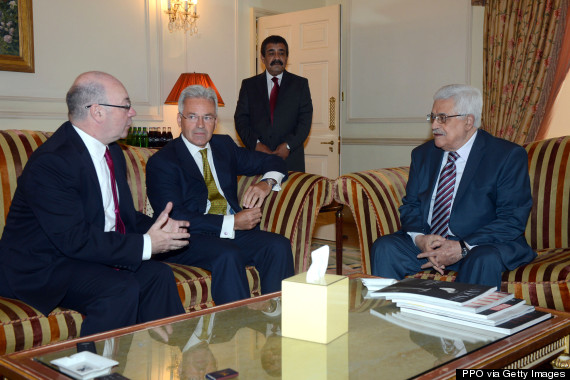
Sir Alan, as a junior minister, meeting Palestinian president Mahmoud Abbas last year
MPs backed a non-binding motion by 274 to 12 in the Commons on Monday evening, which stated: "That this House believes that the Government should recognise the state of Palestine alongside the state of Israel as a contribution to securing a negotiated two-state solution."

The UK government does not classify Palestine as a state, but says it could do so at any time if it believed it would help peace efforts between the Palestinians and Israel. Ministers were told to abstain and the non-binding vote will not force Britain to recognise a Palestinian state.

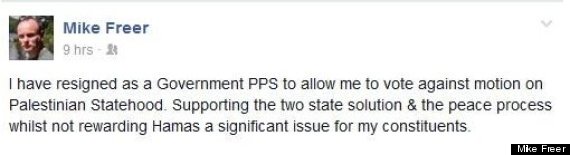
The vote saw one Tory MP, Mike Freer, leave government in order to vote against the motion. Freer, who was ministerial aide to communities secretary Eric Pickles, said that he supported the two state solution while not "rewarding Hamas".
alan duncan
The Huffington Post UK understands that Sir Alan's speech was scheduled prior to the date for this backbench Commons vote being set.
His intervention comes after fellow Tory, Baroness Warsi, resigned as a Foreign Office minister in August citing Britain's "morally indefensible" position on the conflict in Gaza.

Speaking to The Huffington Post UK on the day of her resignation, the Tory peer accused the coalition of failing to act as an "honest broker" in the Middle East and called for an immediate arms embargo against Israel.

"The British government can only play a constructive role in solving the Middle East crisis if it is an honest broker," the former Foreign Office minister said, "and at the moment I do not think it is." '