Saturday, July 19, 2014

4 children playing football on a beach a week after the world cup - killed by an army

http://nymag.com/daily/intelligencer/2014/07/4-palestinian-kids-killed-in-front-of-reporters.html

4 Palestinian Children Killed in Israeli Air Strike Right in Front of Reporters

By 

Nic6349853
Photo: Thomas Coex/AFP/Getty Images
Following yesterday's failed cease-fire, an Israeli naval gunboat has reportedly struck seven children near the port in Gaza, killing at least four. One remains in critical condition. Moments earlier, the kids had been playing soccer with a reporter from NBC, who witnessed the attack firsthand. Dozens of other journalists were nearby.

"The kids were playing football on the beach. They were all ... under the age of 15," a witness confirmed to Reuters. "It looked as if the shells were chasing them."

NBC reports, "They were carried from the scene of the attack, on the beachfront, through the lobby of a hotel in front of Western journalists."
William Booth, a Washington Post reporter, also has a first-person account:
We could smell the charge. I wondered: Did Hamas just fire a rocket? But it was the sound of an incoming missile. We saw a small fisherman’s shack on the quay, churning with gray smoke.
Then we saw a gang of kids running from the shack, down the breakwater and onto the sand, hurtling toward Al Deira. A couple of waiters, the cook and a few journalists starting waving at them. Run here! Then a second missile exploded on the beach right behind them.
The staff were yelling, “They’re hurt!”
A half-dozen kids made it to hotel. The oldest was a teenager, who reached safety and fainted. He was scooped up and carried away to a taxi by the big friendly bear of a bellman, room cleaner and night watchman named Mahmoud Abu Zbaidah.
The Guardian's Peter Beaumont described the scene here.

And, if you can stomach it, here's video of reporters photographing an injured, crying child (via Mashable):
The Israeli military has said it provides evacuation warnings for targeted areas to minimize civilian deaths, but according to NBC foreign correspondent Ayman Mohyeldin, "They don't take those warnings seriously" for two reasons: "It is not clear where they're supposed to evacuate to," he said. "The entire Gaza Strip has been struck." Additionally, Hamas tells Palestinians that the warnings are merely "psychological warfare."

Recent clashes, the worst in years, have killed more than 200 Palestinians — the United Nations estimates about 80 percent have been civilians — and one Israeli.


Reporters being removed from Gaza

http://nymag.com/daily/intelligencer/2014/07/cnn-removes-diana-magnay-from-gaza-after-tweet.html

CNN Reassigns Reporter Who Called Israelis Cheering Bombs ‘Scum’ in Tweet

By 


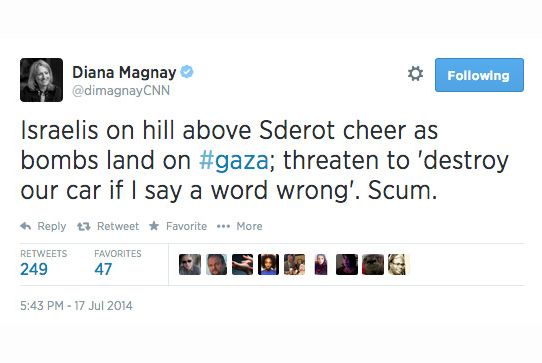
On Thursday night, CNN correspondent Diana Magnay did a report from a hill in southern Israel, where a group of Israelis had gathered to watch the beginning of the ground invasion of the Gaza Strip. As Magnay described the missiles flying through the sky behind her, the spectators could be heard cheering on the bombardment. "It is an astonishing, macabre and awful thing to watch this display of fire in the air," she told Wolf Blitzer before signing off.

Shortly afterwards, Magnay posted this tweet:

Photo: Diana Magnay/Twitter

She quickly removed the message, but not before it had been favorited and retweeted by hundreds of people. Unsurprisingly, the tweet — along with its deletion — led observers to speculate as to whether Magnay was capable of reporting on Israel and Gaza "objectively," while others wondered if CNN had censored an employee's social media presence. By Friday, she had been reassigned to Moscow.
CNN told the Huffington Post's Michael Calderone that Magnay had not intended to call all Israelis "scum" — just the ones present for the segment, who were said to have "threatened and harassed" Magnay and her colleagues "before and during a liveshot." "Diana reacted angrily on Twitter," said a network spokesperson. "She deeply regrets the language used, which was aimed directly at those who had been targeting our crew. She certainly meant no offense to anyone beyond that group, and she and CNN apologize for any offense that may have been taken."
CNN's decision to remove Magnay from Gaza comes just after NBC — citing "security concerns" — pulled correspondent Ayman Mohyeldin from the area after his moving account of the deaths four Palestinian children in an Israeli air strike. While the circumstances surrounding Magnay and Mohyeldin's removals are slightly different, their situations have given people on both sides of the conflict more reason to feel that the media isn't being fair when it comes to reporting what's happening in Israel and Gaza.


http://nymag.com/daily/intelligencer/2014/07/nbc-ayman-mohyeldin-pulled-gaza-palestinian-kids.html

NBC Reporter Who Witnessed Killing of 4 Palestinian Children Removed From Gaza by the Network


Photo: PBS
Ayman Mohyeldin, the NBC correspondent who was playing with a group of Palestinian kids moments before an Israeli attack killed four of them on a Gaza beach yesterday, has been pulled from the region. According to a report by Glenn Greenwald at the Intercept, the network demanded Mohyeldin leave immediately, citing "security concerns," although it also sent a different correspondent, Richard Engel, to Gaza.
While Mohyeldin has experience covering conflict in Israel — NBC poached him from Al Jazeera for his Middle East coverage — Engel's accompanying producer has never covered Gaza from the ground and, according to the Intercept, does not speak Arabic.
Following Mohyeldin's moving first-hand coverage from the beach, which some have seen as anti-Israel, the troubling implications here are obvious.
Mohyeldin, who is Egyptian-American, reported on Wednesday's civilian tragedy both on-air and on social media with chilling details ("Minutes before they were killed by our hotel, I was kicking a ball with them"), photographs, and footage of the victims' grieving families.
The network pushed his exclusive access hard, but by the time Nightly News rolled around, Mohyeldin had been swapped for Engel, NBC's chief foreign correspondent. TV Newser reported last night, "the decision to have Engel report the story for Nightly instead of Mohyeldin angered some NBC News staffers."
Others have noted that Mohyeldin deleted posts he'd made to Twitter and Facebook critical of the U.S. State Department's reaction to the attack:
He'd previously been called a "spokesman" for Hamas, and criticized for "a pro-Hamas rant" by media critics sensitive to an anti-Israel bias.
It's also entirely possible that the network felt Mohyeldin's objectivity had been compromised after witnessing such tragic violence up close. Or, fearing post-traumatic stress, felt he needed, emotionally, to be extricated from the war zone. But if that's the case, NBC should say it, rather than broadly claiming "security concerns."
The network has not responded to a request for comment.

Poem - Waiting, by Anon

http://brownonchumanities.org/uploads/Waiting.pdf

WAITING
by Unknown

The bad news
You might have ovarian cancer
The good news is
You might not
Wait two weeks
We'll do surgery
To find out.
You scream, you rage
You revise your will
But you wait two weeks
Which seem like two years
Then surgeons split you
Down the middle
Peel you apart with retractors
Plunge in, snip and cut

You scream, you rage
It hurts like hell
Morphine gives you a headache
And makes you nauseous
But at least you'll know
Or not
The first pathology report
Is pretty positive
We think you have a
Leiomyosarcoma
(are you kidding?
Is that a real medical name?
It sounds like a bad country lyric)
Which hardly ever comes back
And which we can't really do much about anyway
So - you might as well forget about it.
But you'll have to wait a week.
Till we know for sure

Being a good patient
You forget about it for a week
You have the occasional nightmare
And the less- occasional panic attack
(What if it's not country & western?)
but you wait
Then they call you with real path report
Oops! It's not lie - oh - my-oh
(Although it was a kind of lie)
Instead, we think you have
Endometrial stromal sarcoma
(this one doesn't even sound fun)
only it could be either the high-grade
which kills almost everybody in
about two years
or the low-grade, where you
a fighting chance
to stick around awhile longer
we have to consult with a superlab
so you'll have to wait two more weeks

You rant, you rave, you sob,
You are a crazy person
When the two weeks are up
They're pretty sure it's the good kind of
Bad kind
And they wish they'd known that
When they did the surgery
Because they would've done
A different kind of operation
But it probably won't affect
"your outcome" anyway.

So now you know.
There is nothing more to wait for.
When they pass out these diagnoses
They should pass out the xanax and
The prozac as well
They should give you the number
Of a suicide hotline
They should schedule you for therapy
Five days a week
They should look at your face,
Look in your eyes
And say, this is going to be really, really tough
They should give you a hug
They should say,
Call me if you need to cry.

Drawing drinking water from the atmosphere - warka water

http://www.smithsonianmag.com/innovation/this-tower-pulls-drinking-water-out-of-thin-air-180950399/

This Tower Pulls Drinking Water Out of Thin Air

Designer Arturo Vittori says his invention can provide remote villages with more than 25 gallons of clean drinking water per day

smithsonian.com 


Warka Water towers are designed to take advantage of condensation. (Architecture and Vision )


Read more: http://www.smithsonianmag.com/innovation/this-tower-pulls-drinking-water-out-of-thin-air-180950399/#O2G7j8eKskDBoiS2.99
Give the gift of Smithsonian magazine for only $12! http://bit.ly/1cGUiGv
Follow us: @SmithsonianMag on Twitter

In some parts of Ethiopia, finding potable water is a six-hour journey.
People in the region spend 40 billion hours a year trying to find and collect water, says a group called the Water Project. And even when they find it, the water is often not safe, collected from ponds or lakes teeming with infectious bacteria, contaminated with animal waste or other harmful substances. 
The water scarcity issue—which affects nearly 1 billion people in Africa alone—has drawn the attention of big-name philanthropists like actor and Water.org co-founder Matt Damon and Microsoft co-founder Bill Gates, who, through their respective nonprofits, have poured millions of dollars into research and solutions, coming up with things like a system that converts toilet water to drinking water and a "Re-invent the Toilet Challenge," among others.
Critics, however, have their doubts about integrating such complex technologies in remote villages that don't even have access to a local repairman. Costs and maintenance could render many of these ideas impractical. 
"If the many failed development projects of the past 60 years have taught us anything," wrote one critic, Toilets for People founder Jason Kasshe, in a New York Times editorial, "it's that complicated, imported solutions do not work."
Other low-tech inventions, like this life straw, aren't as complicated, but still rely on users to find a water source.
It was this dilemma—supplying drinking water in a way that's both practical and convenient—that served as the impetus for a new product called Warka Water, an inexpensive, easily-assembled structure that extracts gallons of fresh water from the air.
The invention from Arturo Vittori, an industrial designer, and his colleague Andreas Vogler doesn't involve complicated gadgetry or feats of engineering, but instead relies on basic elements like shape and material and the ways in which they work together. 
At first glance, the 30-foot-tall, vase-shaped towers, named after a fig tree native to Ethiopia, have the look and feel of a showy art installation. But every detail, from carefully-placed curves to unique materials, has a functional purpose.
The rigid outer housing of each tower is comprised of lightweight and elastic juncus stalks, woven in a pattern that offers stability in the face of strong wind gusts while still allowing air to flow through. A mesh net made of nylon or  polypropylene, which calls to mind a large Chinese lantern, hangs inside, collecting droplets of dew that form along the surface. As cold air condenses, the droplets roll down into a container at the bottom of the tower. The water in the container then passes through a tube that functions as a faucet, carrying the water to those waiting on the ground.
Using mesh to facilitate clean drinking water isn't an entirely new concept. A few years back, an MIT student designed a fog-harvesting device with the material. But Vittori's invention yields more water, at a lower cost, than some other concepts that came before it.
"[In Ethiopia], public infrastructures do not exist and building [something like] a well is not easy," Vittori says of the country. "To find water, you need to drill in the ground very deep, often as much as 1,600 feet.  So it's technically difficult and expensive. Moreover, pumps need electricity to run as well as access to spare parts in case the pump breaks down."
So how would Warka Water's low-tech design hold up in remote sub-Saharan villages? Internal field tests have shown that one Warka Water tower can supply more than 25 gallons of water throughout the course of a day, Vittori claims. He says because the most important factor in collecting condensation is the difference in temperature between nightfall and daybreak, the towers are proving successful even in the desert, where temperatures, in that time, can differ as much as 50 degrees Fahrenheit. 
The structures, made from biodegradable materials, are easy to clean and can be erected without mechanical tools in less than a week. Plus, he says, "once locals have the necessary know-how, they will be able to teach other villages and communities to build the Warka."
In all, it costs about $500 to set up a tower—less than a quarter of the cost of something like the Gates toilet, which costs about $2,200 to install and more to maintain. If the tower is mass produced, the price would be even lower, Vittori says. His team hopes to install two Warka Towers in Ethiopia by next year and is currently searching for investors who may be interested in scaling the water harvesting technology across the region. 
"It's not just illnesses that we're trying to address. Many Ethiopian children from rural villages spend several hours every day to fetch water, time they could invest for more productive activities and education," he says. "If we can give people something that lets them be more independent, they can free themselves from this cycle."

House of Lords debate 'Assisted dying bill'

http://www.theguardian.com/society/2014/jul/18/assisted-dying-legalisation-debate-house-lords

House of Lords debate evenly split over assisted dying legislation
, political correspondent
Friday 18 July 2014 
Assisted dying bill would allow doctors to prescribe lethal dose to terminally ill patients judged to have less than six months to live
The House of Lords was split on Friday night over whether to back assisted dying, as supporters argued it would end the excruciating suffering of the terminally ill and opponents warned it was "a whisker away" from euthanasia.
The assisted dying bill, proposed by the former lord chancellor Charles Falconer, would allow doctors to prescribe a lethal dose to patients judged to have less than six months to live. By the end of an emotionally fraught 10-hour debate, about 65 peers had spoken in favour of the legislation and 62 against. There was no consensus among the professions, with doctors, senior lawyers, police chiefs, politicians and the clergy speaking on each side.
The bill's supporters included former police commissioner Ian Blair; former BBC chief John Birt; former director-general of Age Concern, Sally Greengross; former archbishop of Canterbury George Carey; and Elaine Murphy, a professor of old age psychiatry. Many of them raised the rights of individuals to choose their own fate, and argued there has been a shift in public opinion towards legalisation.
Opponents included paralympian Tanni Grey-Thompson; the archbishop of York, Dr John Sentamu; former Conservative cabinet minister Norman Tebbit; Ilora Finlay, a professor of palliative medicine; Jock Stirrup, the former head of the army; Julia Neuberger, who led the review of the Liverpool care pathway; and Ken Macdonald, former director of public prosecutions.
Many warned it would lead to pressure on disabled people not to be a "burden" on relatives. Grey-Thompson questioned whether it would lead to Dignitas-style clinics in Britain and argued it would not provide people with a "Hollywood death". A few even made comparisons with the mass euthanasia undertaken by the Nazis.
Both sides brought up personal experiences of illness, including Janet Royall, the shadow leader of the Lords, and Jeremy Beecham, a senior Labour peer, who said their late spouses would have wanted them to support the bill. On the other side, disability rights campaigner Jane Campbell spoke from her wheelchair, with the aid of artificial respiration, about her fears that it would endanger the vulnerable and tempt her to use it in "periods of greatest difficulty".
With the House so evenly divided, the peers nodded Falconer's bill through to its next stage in parliament for further debate. It is unlikely to make it into law because of a lack of time, but David Cameron, while "unconvinced" of the arguments, has said he is open to a similar debate in the Commons. It comes after the supreme court suggested the matter should be considered by parliament in light of the failed "right-to-die" case brought by the widow of "locked-in syndrome" sufferer Tony Nicklinson.
Opening the debate, Falconer said allowing assisted dying would mean fewer suffering "lonely, cruel" ends at their own hands. "The current situation leaves the rich able to go to Switzerland, the majority reliant on amateur assistance, the compassionate treated like criminals," he said.
He was backed by Blair, who served on a commission on assisted dying that found "no evidence of a slippery slope" towards putting pressure on people to kill themselves. Another supporter was Birt, who said society should not deny individuals "the right to manage their own imminent, irreversible and prospectively painful, wretched, or deeply distressing death". Tory peer Patience Wheatcroft, a former newspaper editor, argued her mother would have "grabbed the loaded gun" of assisted dying when morphine was inadequate to relieve her suffering from leukaemia.
Many peers gave moving speeches against the bill. Tebbit was concerned about "vultures" with an eye on the financial incentives to end the lives of frail, ill and elderly people. He spoke of his wife, who was "crippled almost 30 years ago" in the IRA Brighton bombing, saying: "Those who care for such people are all too familiar with the moments of black despair, which prompt those words 'I would be better dead so that you could get on with your life.'"
Finlay, who has cared for dying patients for 25 years, said she believed the bill "comes within a whisker of full-blown euthanasia".
She also reminded the House of Lords that a second doctor signed off cremation forms for 176 patients murdered by Harold Shipman. One of the fiercest speeches against the bill was given by Emma Nicholson, a former MP, who said the "malign" legislation would lead to a "state death department", while Elizabeth Butler-Sloss, a former judge, criticised the bill's practicalities, saying it contained "utterly inadequate" safeguards.
Closing the debate, Falconer said it was near-unanimous that the House of Lords should "grasp the nettle" and settle the matter through further debate.

'Frightening proposal'

Lady Campbell of Surbiton addressed the Lords from her wheelchair with the aid of artificial respiration. She urged the House to talk to disabled people who oppose the bill and suggested it is a regressive step for those campaigning for disability rights.
"This bill gives no comfort to me. It frightens me because in periods of greatest difficulty, I know I might be tempted to use it. It only adds to the burden and challenges life holds for me. Pain, suffering and disempowerment are treatable. I have to believe that and it should always be treated.
"I have spent my life developing ways to prevent people in vulnerable situations feeling powerless and burdensome. They do get cajoled, they do feel a burden …Assisted dying will bring back outdated beliefs that devalue disabled and terminally ill people that we have tried so hard to get away from."


Friday, July 18, 2014

The real 'Glasgow Girls'


Apparently the original documentary was 'Tales from the edge' directed by Lindsay Hill from BBC Scotland ?2005/2006.


http://www.bigissue.com/features/1942/how-glasgow-girls-took-world


Wednesday, July 16, 2014

An article on looking beyond the labels, and seeing the people and the realities of the current situation

http://www.independent.co.uk/voices/why-im-on-the-brink-of-burning-my-israeli-passport-9600165.html

Why I'm on the brink of burning my Israeli passport

I can no longer stand by while Israeli politicians like Ayelet Shaked condone the deaths of innocent Palestinian women and children

(Body of a 3 year old, face of the far right Israeli minister)


She is young. She is pretty. She is a university graduate and a computer engineer. She is also an Israeli Parliamentarian - and the reason why I am on the brink of burning my Israeli passport. Because behind that wide-eyed innocent face lurks the Angel of Death.
Ayelet Shaked represents the far-right Jewish Home party in the Knesset. This means she is well to the right of Benyamin Netanyahu, just in case you thought such a thing was not possible.
On Monday she quoted this on her Facebook page:  “Behind every terrorist stand dozens of men and women, without whom he could not engage in terrorism. They are all enemy combatants, and their blood shall be on all their heads. Now this also includes the mothers of the martyrs, who send them to hell with flowers and kisses. They should follow their sons, nothing would be more just. They should go, as should the physical homes in which they raised the snakes. Otherwise, more little snakes will be raised there.”
A week earlier, just before 17-year-old Mohammed Abu Khudair was snatched and burned alive, Shaked wrote: “This is not a war against terror, and not a war against extremists, and not even a war against the Palestinian Authority. The reality is that this is a war between two people. Who is the enemy? The Palestinian people. Why? Ask them, they started it.”
So even before the boy died horribly she declared him to be the enemy, and afterwards, without any apparent hint of guilt or remorse, she was calling for the deaths of innocent women and their unborn babies.
She made me think about my mother’s sister Klara and her three small children who were living in Krakow in 1939 when the Germans invaded. They decided that the Jews – all Jews – were the enemy and had to be eliminated, not least the women and the little snakes they were raising. “Why? Ask them – they started it”, as the Nazis would say if asked.
I never met Klara or her children who had perished by 1942. I did meet my uncle Romek, who survived by working in Oskar Schindler's factory, and his wife Yetti who survived because she spoke good German and was able to pretend she was a fine German woman who had kicked out her Polish Jewish husband, as she smiled prettily at every Nazi she came across.

My father’s brother Shmuel and his young family also perished before I was born, taken in Holland, to where they had escaped from Berlin, to the same camp Anne Frank died in.
I know what it is to have been helpless victims, living and dying under racist oppressors’ boots, and I know that today’s Israelis are no longer the victims but the perpetrators of the current crisis. Yes, Hamas are dreadful hate-filled killers and woe betide Israel had they had the wherewithal to carry out their intentions. But the fact remains that it is Israel which has the tanks, bombers, artillery, nuclear warheads and missile defences of Goliath, while ordinary Gazans had nothing a week ago and even less today, as even hospitals and schools were bombed.
Shaked got what she wanted: the death toll in Gaza is nearing 100, one in four being children. Hundreds more have serious injuries in a place where hospitals have also been bombed and medical essentials are running out.

In Israel, in spite of Hamas’s best efforts, not one death has been recorded, nor any serious injuries, although a wedding party was disrupted and got on the television news.
And, as the bombs rain on Gaza, Israeli teens have taken to tweeting scantily-clad selfies alongside their political sentiments.  In two now deleted tweets, one wrote “Death to all of you Arabs you transfag”, while another proclaimed “Arabs may you be paralyzed & die with great suffering!”  Another teen simply tweeted “Death to these f****** Arabs”, and attached a photo of themselves pouting alongside it.
Seeing these angelic faces of evil spouting such genocidal rhetoric, I pick up my Israeli passport and a box of matches. “Not in my name, people. Not in my name!”